Project ongoing · Quantum computing
Quantum
We use quantum computing to read medical images better.
- the layers of a QCNN on N qubits
- log N
- for each convolution gate
- 2 qubits
- the qubits measured at each pooling step
- 1 out of 2
- from the image to the class
- 4 steps
For people who come from physics, computer science, medicine
The problem
To recognise a tumour in an MRI scan, a convolutional neural network, a CNN, learns from thousands of examples. In medicine the examples are few, and the labels are set by doctors who do not always agree with each other, or even with themselves at a later time.
With data like this, large CNNs memorise the errors too and generalise poorly. Measuring them is difficult too: in two competitions on Kaggle with fewer than 1000 test cases, the gap between the public leaderboard and the private one was bigger than the gap between the winner and the top 10%.
The qubit and the Bloch sphere
A bit is worth 0 or 1. A qubit can be in a superposition of the two: its state is a point on the surface of a sphere, the Bloch sphere. At the north pole there is |0⟩, at the south pole |1⟩, on the equator the halfway superpositions, like |+⟩ and |−⟩.
|ψ⟩ = cos(θ/2) · |0⟩ + e^(iφ) · sin(θ/2) · |1⟩

θ   from 0 to π, the latitude measured from the north pole
φ   from 0 to 2π, the longitude on the equator

point on the sphere = (sin θ · cos φ, sin θ · sin φ, cos θ)Quantum logic gates are rotations of the sphere. X, Y and Z turn the state by half a turn around their axes; the Hadamard gate turns around the axis halfway between x and z, and takes |0⟩ to |+⟩.
| |0⟩ | north pole | +z axis |
|---|---|---|
| |1⟩ | south pole | −z axis |
| |+⟩ | equator | +x axis |
| |−⟩ | equator | −x axis |
| |+i⟩ | equator | +y axis |
| |−i⟩ | equator | −y axis |
The quantum convolutional network
A QCNN brings the idea of CNNs to qubits. The convolution is a row of two-qubit gates, the same across the whole layer, on pairs of neighbouring qubits. Pooling measures half the qubits and uses the results to rotate the ones that remain. Layer after layer the qubits halve, until a measurement gives the class.
The advantage is in the numbers: on N qubits, about log N layers are enough, and the parameters to learn grow as log N. And it has been shown that a QCNN does not fall into barren plateaus, the flat plateaus where the training of many quantum circuits stalls.
The numbers in the chart
| Layer | Qubit |
|---|---|
| Input | 8 qubit |
| After the first pooling | 4 qubit |
| After the second | 2 qubit |
| Output | 1 qubit |
What we know and what we do not know
Papers from 2025 and 2026 show that many QCNNs used today can be efficiently simulated even on a classical computer, because they work well mainly on data that is easy to read with local measurements.
On brain MRI scans the published numbers are still low. This is why we do not promise a quantum advantage: our work is to measure it, on equal terms, against classical methods and on the same data.
The numbers in the chart
| Task | Accuracy |
|---|---|
| Two classes (tumour or not) | from 88 to 89% |
| Four classes (three tumours or none) | from 52 to 62% |
The path of the project
- 1A medical image, for example a brain MRI scan.
- 2Processing on a real quantum computer.
- 3Comparison with the other methods.
- 4Classification: which group the image belongs to.
As of April 2026 the quantum code is ready for testing.
The public data
For this problem there are public collections of brain-tumour MRI scans, already labelled. The main ones:
| Brain Tumor MRI, Kaggle | 7,200 images | 4 classes: glioma, meningioma, pituitary, no tumour |
|---|---|---|
| Figshare, Cheng and colleagues | 3,064 images | from 233 patients, 3 types of tumour |
| BraTS 2021 | 2,040 patients | 4 MRI sequences, with the tumour outlines |
Where we are
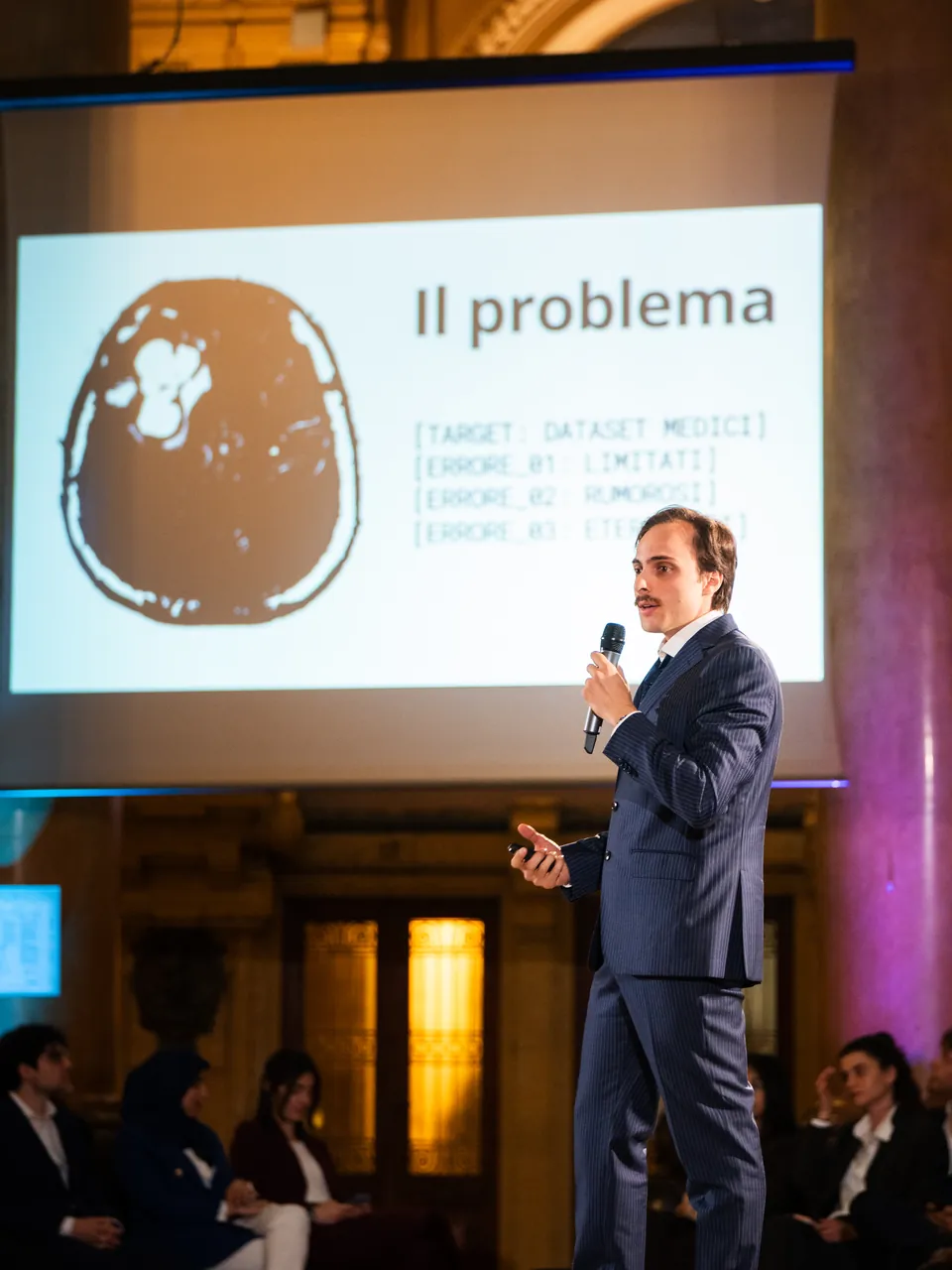
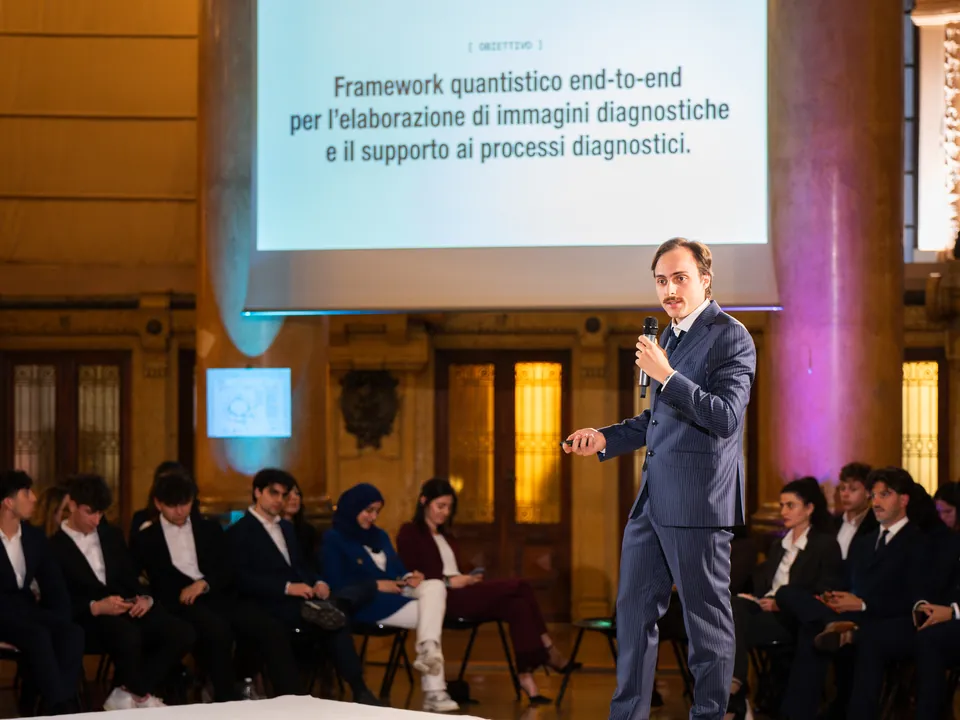
- April 2026We presented the project at Palazzo della Borsa: the quantum code is ready for testing.
- Next stepRun the whole pipeline on a real quantum computer and compare it with classical methods, on the same data.
Photos
Videos

People on the project
Who we do it with

Sources
- Cong, Choi and Lukin, Quantum convolutional neural networks, Nature Physics, 2019.
- Pesah and colleagues, Absence of Barren Plateaus in Quantum Convolutional Neural Networks, Physical Review X, 2021.
- McClean and colleagues, Nature Communications, 2018; Bermejo and colleagues, PRX Quantum, 2026.
- Karimi and colleagues, Medical Image Analysis, 2020; Varoquaux and Cheplygina, npj Digital Medicine, 2022.
- Nugraha and colleagues, arXiv:2509.02582, 2025.
- IBM Quantum Learning, Bloch sphere.
- Presentation at the Deep-Tech Showcase, Palazzo della Borsa, 21 April 2026.
Do you want to work on it?
You do not need experience and you do not need a CV. Write to us: we invite you to the next meeting, where you meet the team.