Project ongoing · Physics
Zero-G
We design experiments to run in weightlessness, during parabolic flights.
- of weightlessness on each parabola
- 8 s
- the peak, going into and out of the parabola
- 1.8 g
- experiments in flight, on 19 November 2025
- 2
- the CanSat module, for a flight on a rocket
- 66 × 115 mm
For people who come from physics, engineering, biology
The parabolic flight
An aircraft in level flight pulls its nose up and climbs: for a few seconds whoever is on board weighs 1.8 times normal. Then the pilot cuts thrust and the aircraft follows the parabola of a thrown stone. Aircraft, people and experiments fall together, and inside the cabin, weight disappears. At the end the aircraft returns to level flight, passing again through 1.8 g.
On the Airbus A310 ZERO-G, which flies for the European space agencies, weightlessness lasts from 20 to 22 seconds, over 31 parabolas per flight. On a small general aviation aircraft it lasts about 8 seconds, with 4 to 6 parabolas per flight, but costs much less. Our flight, on 19 November 2025, was offered to us by RINA and QBT.
- Pull-up to 1.8 g the aircraft pulls its nose up
- 8 seconds without weight aircraft and experiments fall together
- Pull-out at 1.8 g the aircraft returns to level flight
The numbers in the chart
| Time (s) | Gravity on board (g) |
|---|---|
| 0 | 1 |
| 5 | 1 |
| 6,5 | 1,8 |
| 11 | 1,8 |
| 12 | 0 |
| 20 | 0 |
| 21 | 1,8 |
| 25,5 | 1,8 |
| 27 | 1 |
| 32 | 1 |
The numbers in the chart
| Aircraft | Duration per parabola |
|---|---|
| Airbus A310 ZERO-G (aircraft for parabolic flights) | from 20 to 22 s |
| Small aircraft (as in our flight) | about 8 s |
The Hele-Shaw cells
A Hele-Shaw cell is two glass plates very close together. The fluid that flows between the plates moves like water in a porous rock: because of this, the cell is a small laboratory for porous materials, chemical microreactors and lab-on-chip devices.
Our cells are full of distilled water and lit from behind. A syringe pump blows air bubbles at a constant flow rate and a phone films the whole flight. On the ground the bubbles rise, pushed by buoyancy; at 1.8 g they rise faster; without weight, buoyancy disappears, and only surface tension and viscosity matter.
Published experiments show how much gravity matters: when one fluid pushes another in a Hele-Shaw cell, the front breaks up into fingers. On parabolic flights the distance between the fingers is about 3 times the thickness of the cell without weight, against about 5 times on the ground.
| Cells | glass, very thin | full of distilled water |
|---|---|---|
| Bubbles | air | blown at a constant flow rate |
| Pump | syringe | infusion |
| Light | from behind | to see the outline of the bubbles |
| Mount | wood | fixed to the aircraft |
| Recording | phone | for the whole flight, including at 1.8 g |
Jurin's law
In a thin tube a liquid rises on its own: the forces between the liquid and the glass pull it up, until the weight of the column balances them out. The height of the column is given by Jurin's law.
h = 2 · γ · cos θ / (ρ · g · r)

h   height of the column
γ   surface tension of the liquid
θ   angle between the liquid and the glass
ρ   density of the liquid
g   acceleration due to gravity
r inner radius of the tubeAt 1.8 g the column shortens by 1.8 times. At 0 g there is no longer an equilibrium height: the liquid keeps rising for as long as there is tube left.
Viscosity is not in the formula: it decides how long it takes to get there, not where it ends up. This is why we chose three very different liquids: water as a reference, dimethyl ether, which has low viscosity, and glycerol, about 1400 times more viscous than water. At room temperature, dimethyl ether is only liquid under pressure, at about 5 bar.
The numbers in the chart
| Liquid | Height of the column |
|---|---|
| Water (at 1 g) | 29,7 mm |
| Water (at 1.8 g) | 16,5 mm |
| Glycerol (at 1 g) | 20,5 mm |
| Glycerol (at 1.8 g) | 11,4 mm |
The next step: an experiment on a rocket
On a rocket, the thrust of liftoff becomes a laboratory: for a few seconds the acceleration reaches many times that of gravity. We are designing a biophysics experiment for Colombo 3, the rocket built by our Rocket team.
There are two subjects. Living cells: how acceleration deforms the cytoskeleton and the organelles, and whether it changes the way the cell uses its genes. Protein crystals: the ones grown in orbit are bigger and more regular, but on re-entry to Earth they suffer impacts of up to 67 g and are damaged. Reproducing those impacts helps us understand how to protect them.
The payload follows the European Rocketry Challenge rules: at least 1 kg, in a standard format. Our module is a CanSat: a cylinder 66 mm in diameter and 115 in height, between 300 and 350 g, completely independent from the rocket.
| Minimum payload | 1 kg | no upper limit |
|---|---|---|
| CanSat format | 66 × 115 mm | from 300 to 350 g per module |
| CubeSat format | 100 × 100 × 100 mm | from 1000 to 1330 g |
| PocketSat format | 50 × 50 × 50 mm | from 200 to 250 g |
| Ballast | must be able to replace the payload | without changing the rocket's flight |
Where we are
- Summer 2025We chose the two experiments: Jurin's law and bubbles in Hele-Shaw cells.
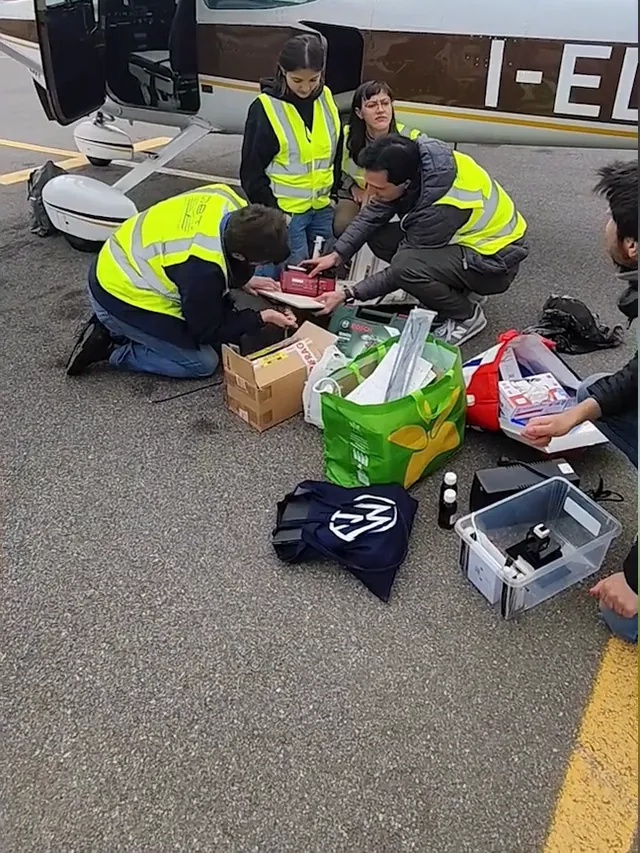
- 19 November 2025We took the two experiments on a parabolic flight, with RINA and QBT, and filmed the whole flight.
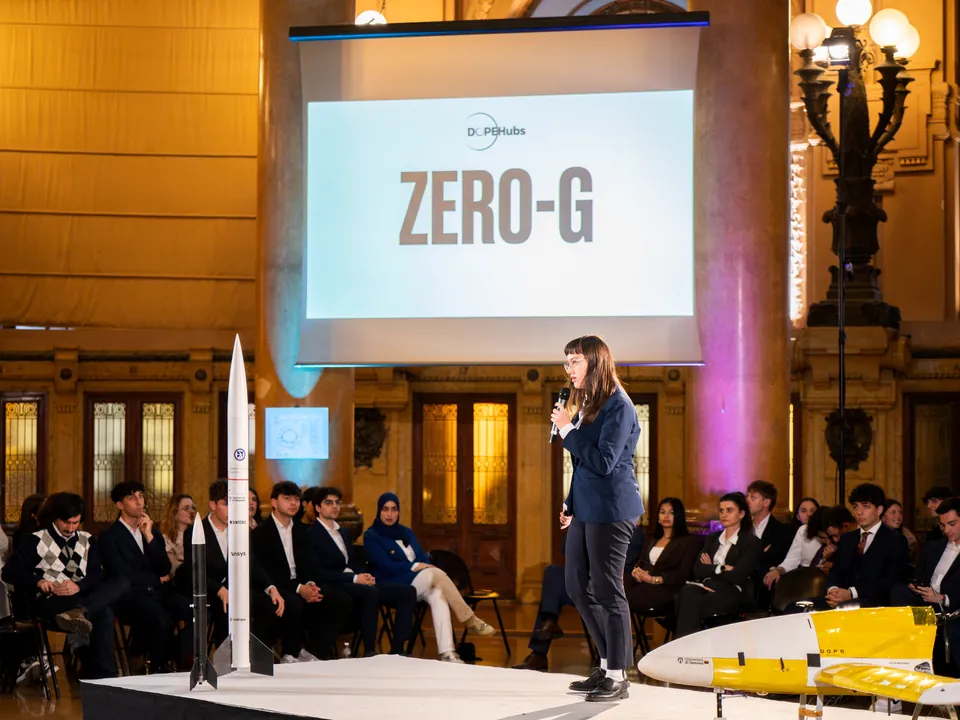
- After the flightWe presented the first results at a physics conference, at the University of Genoa, the first in a series with RINA.
- TodayWe are processing the data for a publication, and designing an experiment to take on a rocket, in CanSat format.
Photos
Videos

Who we do it with


Sources
- Presentation at the Deep-Tech Showcase, Palazzo della Borsa, 21 April 2026.
- Presentation of Zero-G at the event on 11 December 2025.
- ESA, European Users Guide to Low Gravity Platforms, chapter on Parabolic Flights.
- QBT, the G0Flight parabolic flight service: g0flight.ch.
- Miscible viscous fingering in microgravity, Physics of Fluids 21, 054107, 2009.
- McPherson and DeLucas, npj Microgravity, 2015, on protein crystals in orbit.
- European Rocketry Challenge, Rules and Requirements, version 5, 2024.
Do you want to work on it?
You do not need experience and you do not need a CV. Write to us: we invite you to the next meeting, where you meet the team.