Project ongoing · Aerospace
UAS Challenge
We build fixed-wing drones for the UAS Challenge, the drone competition between universities in the United Kingdom.
- Panissa at the UAS Challenge 2026, first Italian team
- 4th out of 54
- Acciuga in 2025, with the Advancement Award
- 6th out of 42
- the wingspan of Panissa, from the CAD
- 2984 mm
- the maximum take-off mass, in 2026
- 10 kg
For people who come from aerospace engineering, mechanical and electronic engineering, computer science
The competition
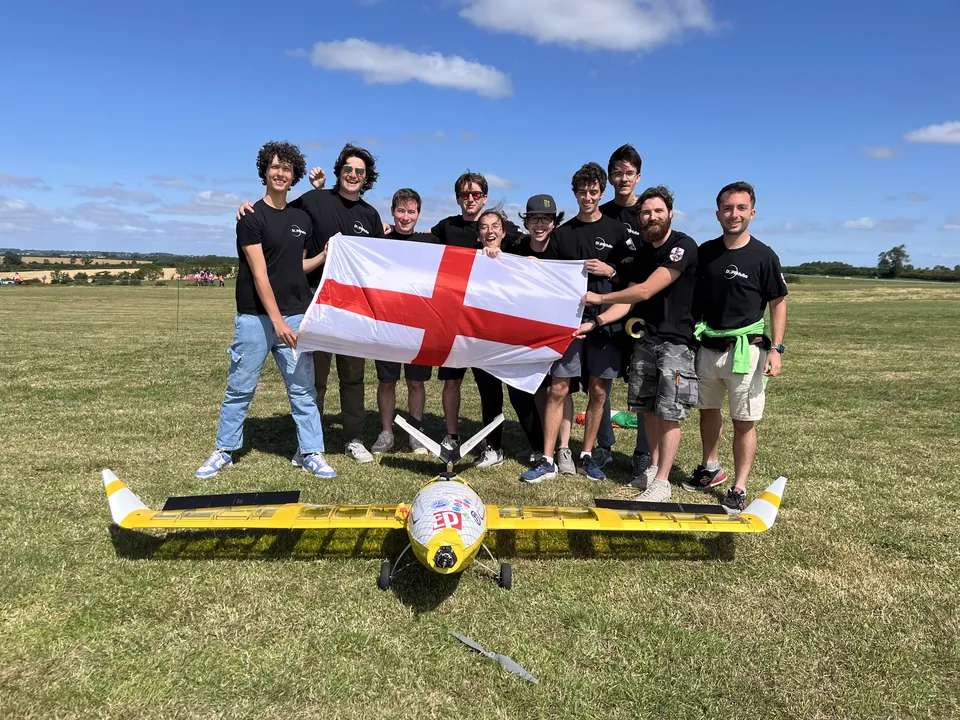
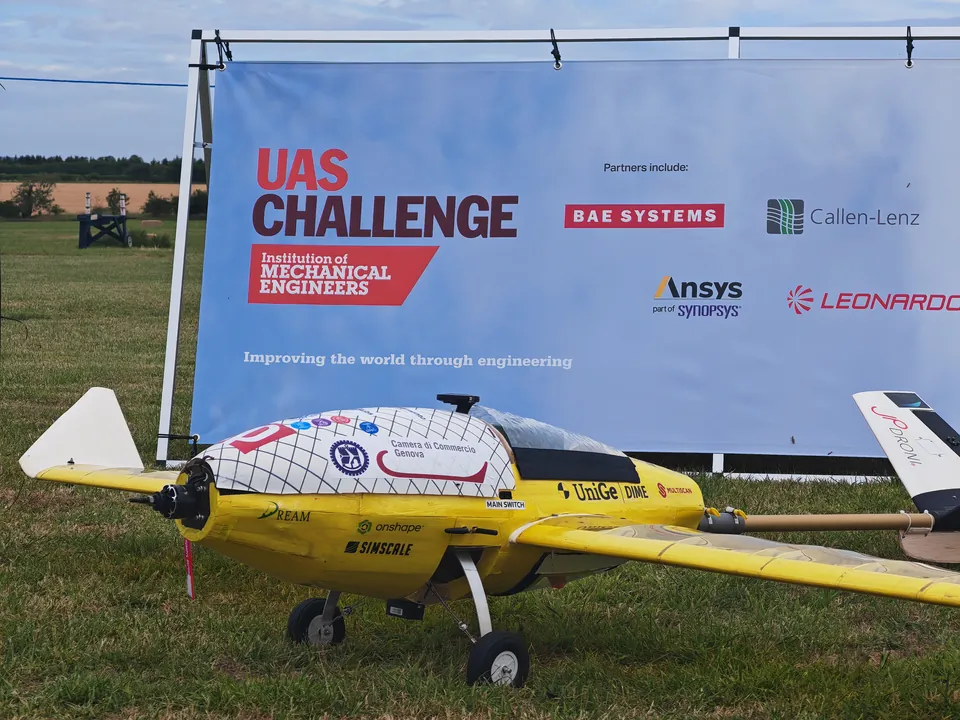
The UAS Challenge is the competition of the Institution of Mechanical Engineers, in the United Kingdom: university teams from all over the world design, build and fly fixed-wing drones on their own. Before flying you hand in the design and the documents; in the competition the flights, the precision and the safety count. The mission changes every year.
In 2025, at our first entry, Acciuga came sixth out of 42 teams and won the Advancement Award, the prize for the team that made the biggest technical progress over the whole path.
In 2026 Panissa made the first automatic flight on the planned route. In the following tests a gust brought it down, with serious damage to the structure: the team repaired the fuselage during the night, and the next day the drone took the maximum score in the manual flight test. In the end, fourth out of 54, first Italian team.
The numbers in the chart
| Edition | Teams | Position |
|---|---|---|
| 2026 | 54 | 4th, first Italian team |
The numbers in the chart
| Edition | Teams | Position |
|---|---|---|
| 2025 | 42 | 6th, Advancement Award |
The 2026 mission
In 2026 the mission was agricultural: to spread a liquid without stopping for 75 metres, flying less than 20 feet above the ground, that is about 6 metres. The drone had to take off and land on its own in a square of 20 metres by 20.
The rules set tight limits: 10 kg at take-off at most, 15 minutes of flight with 20% of battery left, and less than 8 minutes to assemble it on the field.
| Take-off mass | 10 kg at most | |
|---|---|---|
| Endurance | 15 minutes | with 20% of battery in reserve |
| Take-off and landing | on its own | in an area of 20 × 20 m |
| Release | continuous for 75 m | below 20 feet, about 6 m |
| Assembly | less than 8 minutes | on the competition field |
What Panissa is like
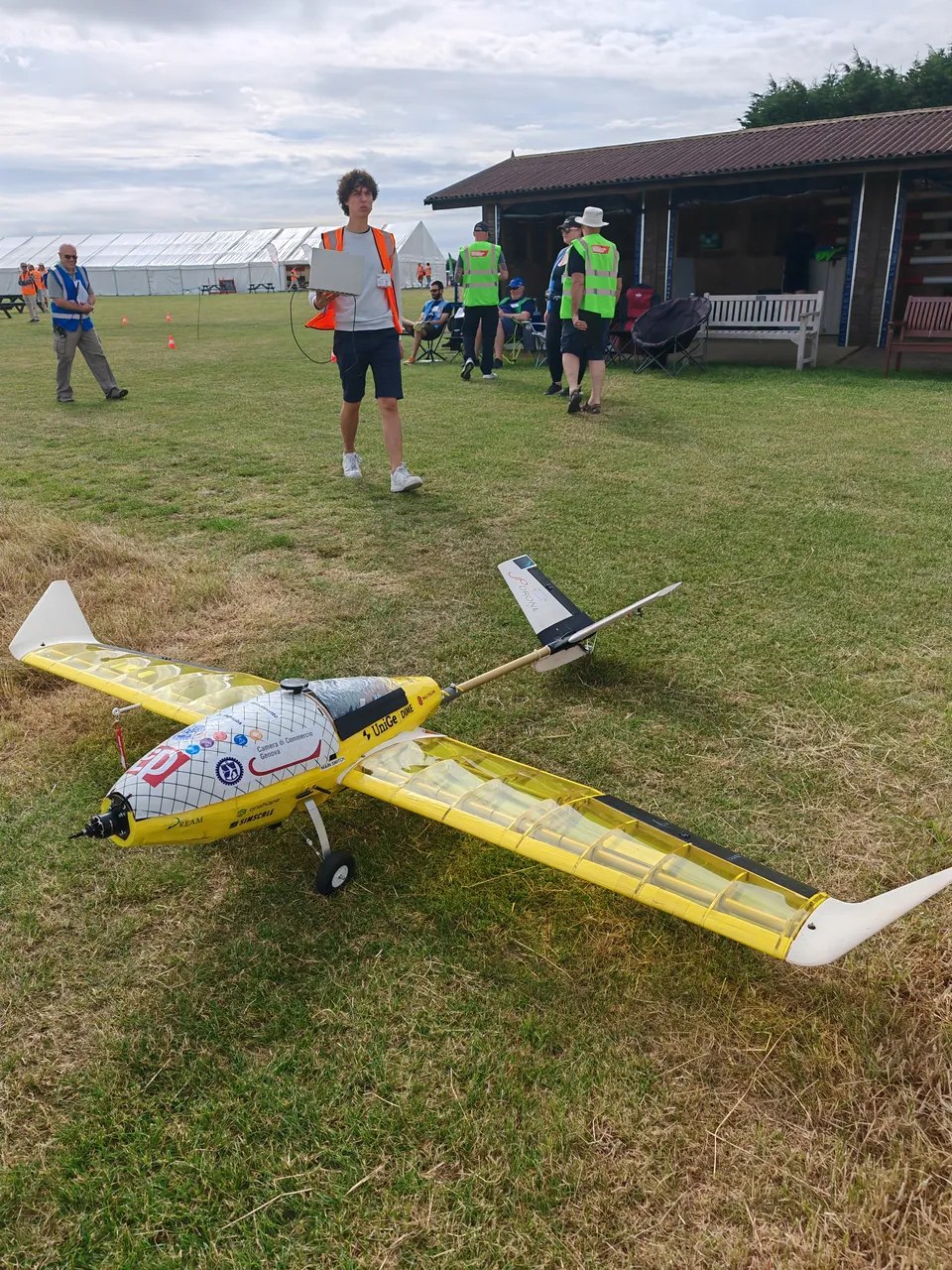
Panissa has a straight, long wing, mounted halfway up the fuselage: the chord is 430 mm near the fuselage and goes down to 300 mm towards the tips, where the wing bends up into the winglets. A wing like this flies for a long time on little energy, at 13 metres per second. The propeller is on the nose, the tail is a V at the end of a thin boom, and on the ground the drone rests on two wheels and a tailwheel.
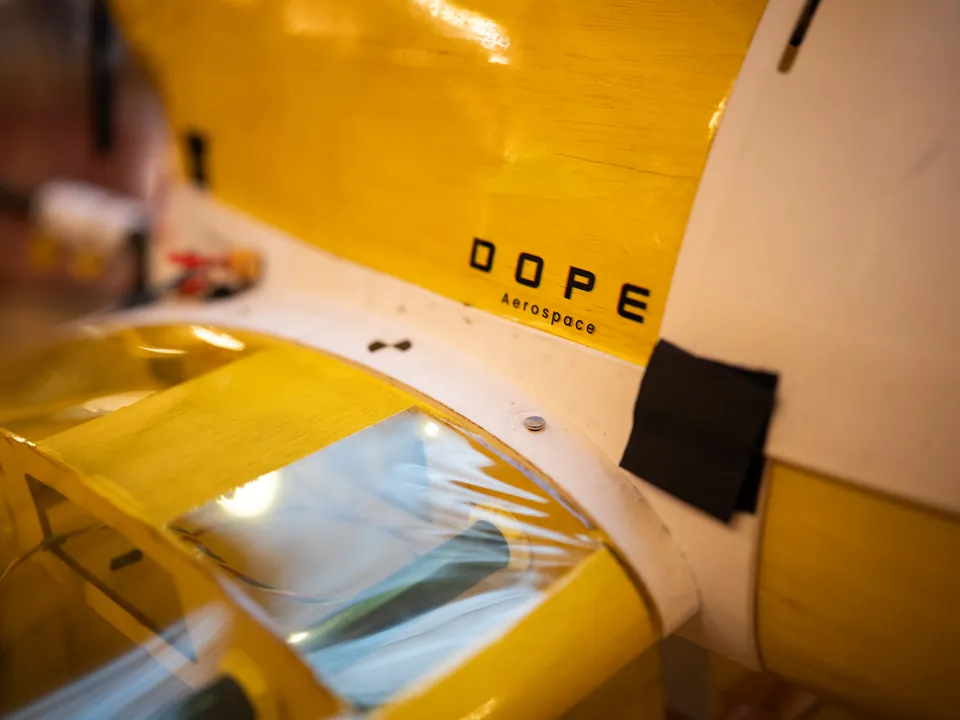
The structure uses light composites with bamboo fibre, flax and balsa wood; the fuselage is a Kevlar sandwich, and it is the one that held up during the night repair at the competition. A LIDAR sensor measures the distance from the ground during the approach, and the important systems are doubled. For the shape of the wing we took ideas from the wings of birds of prey and from the fins of whales.
| Span | 2984 mm | between the tips of the winglets |
|---|---|---|
| Length | 1860 mm | from the nose to the tail |
| Wing chord | from 430 to 300 mm | straight leading edge, tapered trailing edge |
| Wing area | about 1.03 m² | in plan, including the part inside the fuselage |
| Aspect ratio | about 8.7 | span squared divided by the area |
| Wing thickness | 52 mm | 12% of the chord |
| Fuselage | 950 × 283 × 310 mm | length, width, height |
| Tail boom | diameter 35 mm | |
| V-tail | span 656 mm | dihedral of about 37° |
| Landing gear | wheels of 110 mm | track 415 mm; tailwheel of 75 mm at 1215 mm from the wheels |
| Cruise speed | 13 m/s | about 47 km/h |
Acciuga, the first drone
The first design, handed in in November 2024, was not convincing. In January 2025 the team started again from scratch, from the requirements of the rules. The mission that year was humanitarian: to carry a relief package and drop it on a target. In five months Acciuga took shape: a low straight wing, with a constant chord of 500 mm and curved winglets, a short shell with the propeller behind, pushing instead of pulling, a boom and the V-tail.
Almost every piece is 3D printed. Flax is everywhere, including the laser-cut ribs; the spars are carbon, with balsa and aluminium where they are needed. Before building: CAD, CFD simulations and a flight model for the X-Plane simulator.
At the competition Acciuga took off on its own in less than 10 metres, stayed stable in the strong wind, finished the route 2 minutes early, dropped the package on the target and landed on its own, with no mistakes.
- November 2024First design handed in.
- January 2025We start again from scratch, from the requirements of the rules.
- March 2025Complete design: airfoil, tail, stability, winglets, ailerons.
- 4 April 2025Flight model for the X-Plane simulator handed in.
- 12 June 2025First flight, manual. The next day the airworthiness certificate arrives.
- June 2025Second flight: package dropped with the parachute.
- July 2025At the competition: sixth out of 42 and the Advancement Award.
Two drones, two choices
From one year to the next the team changed almost everything, keeping what had worked: the long wings with the winglets, the tail boom with the V-tail. Panissa is bigger, but it has almost the same wing area as Acciuga, spread over a longer and narrower wing: for the same area, a wing with a higher aspect ratio has less induced drag, the drag that comes from holding up the weight.
The numbers in the chart
| Measure | Panissa, 2026 | Acciuga, 2025 |
|---|---|---|
| Span | 2984 mm | 2625 mm |
| Length | 1860 mm | 1805 mm, without the tail |
| Wing chord | from 430 to 300 mm | 500 mm |
| Wing area | about 1.03 m² | about 1.00 m² |
| Aspect ratio | about 8.7 | about 6.9 |
| Part | Panissa, 2026 | Acciuga, 2025 |
|---|---|---|
| Wing | mid, tapered towards the tips | low, constant chord |
| Winglets | straight, angled at about 45° | curved upwards |
| Aspect ratio | about 8.7 | about 6.9 |
| Propeller | tractor, on the nose | pusher, behind the shell |
| Landing gear | two wheels and a tailwheel | three wheels |
| Tail | V, on a 35 mm boom | V, on a 30 mm boom |
| Fuselage | Kevlar sandwich | flax and 3D printing |
| Mission | agricultural, continuous release | humanitarian, package with a parachute |
Where we are
- July 2025At our first competition we came sixth out of 42 universities and we won the Advancement Award.
- April and May 2026We built the drone and in May we tested it in flight.
- From 29 June to 2 July 2026With the drone Panissa we came fourth, first among the Italian teams. The wind brought it down: we repaired it in one night.
- 2027We are preparing the next competition.
Photos
Videos


People on the project



Who we do it with









Sources
- Team CAD: CFD model of Panissa, 2026, and model of Acciuga, 2025.
- Presentation at the Deep-Tech Showcase, Palazzo della Borsa, 21 April 2026: rules and dimensioned drawing.
- DOPE press release on the UAS Challenge 2026.
- UniGe.life, 6th place in the world and Advancement Award at the UAS Challenge 2025, 9 July 2025.
- Competition photos and videos from the team, 2025 and 2026.
Do you want to work on it?
You do not need experience and you do not need a CV. Write to us: we invite you to the next meeting, where you meet the team.